
How it Began: Part III
An Introduction to a Special Portuguese Town

As beautiful as all the historic “touristy” sites were, the small, picturesque city of Alcobaça, where Eve and John lived, stole my heart. Home to approximately 6,000 residents, the city drew me in with its authenticity.
The town looked magical, swathed in Christmas displays and decorations on every roundabout, light pole, tree and shop, and strung with brightly lit icicle lights draped over streets and walkways. As we wandered the cobblestone streets and narrow alleyways, I felt as though I were walking in a fairyland.


The city goes all out for Christmas! Every tree, pole and building are decorated.
The city, nestled in the valleys of the rivers Alcoa and Baça—hence the name—is most known for the massive Alcobaça Monastery where it has stood since 1153. In its era it became the most influential monastery in the country with a population of almost 1,000 monks.
I gasped when I first saw the quiet giant as we walked through the narrow streets with my friends and rounded the corner into the central part of the village. The grounds were lavishly decorated for the season, and small huts, where vendors selling Christmas sweets and crafts displayed their wares, dotted the area. A merry-do-round and ice skating rink had been installed for entertainment.
Awed by the monastery’s looming size and beauty, I “re-remembered” how much deeper the history of Europe extends when compared to my youngster-of-a-country. Colonial Williamsburg, the capital of Virginia in 17th and 18th century Colonial America, located only 20 miles from my home in Newport News, seemed modern by comparison.
The monastery dressed in its holiday finest and the nearby shops on the opposite side of the street.
Surrounding the monastery, a circle of quaint shops, restaurants, coffee and pastry shops and pubs formed the heart of town. Most of the shops were adorned with the famous Portuguese azulejos tiles, often blue but also found in multiple pastel colors.
The outdoor tables teemed with people, even in winter. As we walked through the area, I was delighted by their laughing, eating and drinking, and I wished I could speak the language so that I could join them.
I wondered if the locals took their beautiful surroundings for granted, as often happens when living in splendor, or if they recognized how special their home was. Thinking about my own home and the distinctive places I no longer “saw” because they had become ordinary, I was determined to become more grateful for the loveliness in my own backyard.
I learned that the town center remains busy throughout the year, often hosting live music by local bands during summer months, as well as festivals, parades, antique shows and craft fairs on the monastery grounds.
I pulled out my phone and researched the history of the Gothic monastery and read that the church remains active, and various rooms function as a hotel, concert halls and festival sites. Now a UNESCO World Heritage Site, it was shuttered as a monastery, along with many others in Portugal, in 1834.
While we didn’t take the time to tour the monastery interior during the visit, Eve and John told us about the famous legend its walls hide. Inside lie the tombs of King Pedro I and his mistress, Ines de Castro, the players in a true-to-life, tragic Portuguese “Romeo and Juliet” story.
The king had forced his son to marry Constança Manuel for a political alliance with Castile. Pedro, ever the romantic, followed his heart, and, after his wife’s death in childbirth, refused to remarry and declared his love for Ines. Pedro’s father, who forbade his son’s relationship with the lady-in-waiting, ordered Ines’s assassinated in 1355.
After her murder and his father’s death, Pedro exhumed his lover’s corpse and crowned her queen. This gruesome but beloved story remains an important symbol of love and loyalty in Portugal.
The “Cinderella story,” romantic and charming on its surface, reminded me that, historically, marriage was a decision forced on people, especially women. Rather than a choice made out of love, marriage was a contract that joined families for political and economic reasons. I thought about the many women worldwide still viewed as negotiable property rather than human beings with their own wills and desires. In spite of its messiness and necessary compromise, marriage in my culture is a decision we have the right, thankfully, to make ourselves.
Up the hill from the town center, city hall, one of my favorite buildings, looked nothing like any municipal building I’d ever seen. Among the residents—as least the immigrants—it’s known as “The Pink House.” I half expected to see Rapunzel letting down her hair from the top of the three-story building crowned with steep, pointed roofs and cone-shaped caps. I wondered what it would be like to visit inside the building for routine business such as obtaining a business license or paying fines.
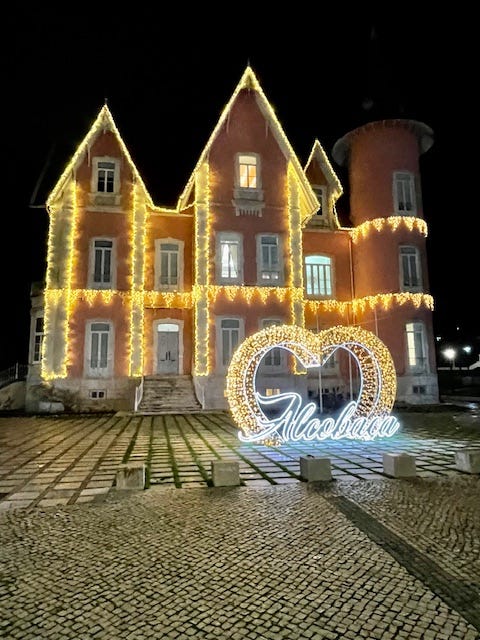
The Alcobaça City Hall, otherwise known as “The Pink House”
Built as a private home in 1890 by Francisco Oriol Pena, Chalet da Familia Oriol Pena became the city hall after Pena’s death without heirs, and the local council purchased the property in 1948. The mansion, one of several casas dos Brasilerios (Brazilian houses) was built by a Portuguese man who moved to Brazil, amassed wealth and later returned. A similar chalet, a blue palace used as a child daycare center and pre-school run by local nuns, adds to the town’s unique architecture.
During my Christmas-time visit, a huge open heart-shaped light installation featuring the name of the town highlighted the building. We couldn’t resist posing behind the large, frame-like holiday decoration. A perfect Christmas card in the making!
Prior to the trip, Eve had alerted Belinda and me to pack something festive for a holiday party. As clients of the relocation service, Eve and John were among the guests, and we were invited to tag along. Eve, a knockout in her black, sparkly dress, arrived with her handsome, tastefully dressed husband. Belinda and I sported simple holiday sweaters.
The party, held in a beautiful old restaurant downtown, housed hundreds of clients of the business that assisted with their moves, now living in cities and towns all over Portugal. We enjoyed a rollicking time with good food, live music, dancing and friendly conversation with dozens of immigrants who’d relocated from cities all over the U.S.
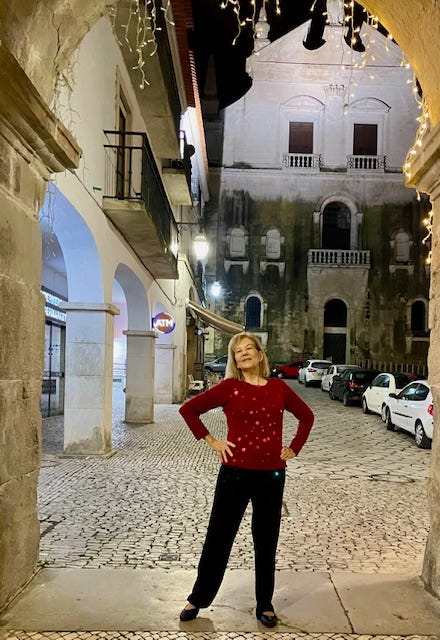
Posing outside the restaurant where the Christmas party was held
The lovely restaurant, tucked within a stone alcove, is owned by a former professional opera singer, tenor Joáo Paulo Ferreira and his husband. At 12:30 p.m. daily, Joáo performs a sample of the opera that dinner guests can anticipate when they made reservations for the evening. During our meandering throughout the area on the way to enjoy a coffee and a pastel de nata, his magnificent voice echoed throughout the town, adding to the small city’s personality.
On the day before Belinda’s and my departure, John and Eve whisked us to Lisbon. With limited time to explore the capital city, we focused our visit on Praca do Comercio. The large harbor and plaza, a location for political demonstrations and festivals for more than 100 years, serves as a transportation and commercial hub.


Scenes from Praca do Comercio in Lisbon
Stunning yellow buildings, shaped like a “U” open towards the Tagus River, surround the plaza. Galleries hug the ground level, and the arms of the “U” terminate in two large towers. The entire area, along with much of Lisbon, was leveled by a devastating earthquake in 1755 and was rebuilt over the years, with completion in the 19th century.
After passing through the stone Rua Augusta Arch that serves as an entrance, we wandered around the open plaza, crackling with activity. We admired the hundred-foot contemporary Christmas tree installation and the 46-foot bronze statue of King Jóse astride a horse.
Street performs in Lisbon near Praca do Comercio
Street performers provided impromptu entertainment and two men, dragging large wands through pans of soapy liquid, created enormous bubbles that floated high above us. People lined up to snap photos with life-sized yellow letters forming the word “LISBOA” near the water. Although I prefer small towns to large cities, I could see how the city would be a draw for tourists and residents desiring a faster-paced life found in the more rural areas.
Afterwards, the couple dropped Belinda and me at our hotel near the airport for our flight the next day. That evening, Belinda remarked on what an incredible adventure we’d experienced over the past week.
“I love this, but I could never move here away from home like Eve and John,” Belinda said.
“I think I could,” I said.
While I’d had expressed similar sentiments about living in other places I’d visited, this felt different.
Three weeks in Europe had reawakened old dreams about living there again. I never expected to be so starstruck by Portugal, but I was wowed by the beauty and joie de vivre of the lifestyle that Eve and George had found. Could it ever be possible for me?
I tucked the idea of living in Portugal into the back of my mind. My life was in Virginia, and I looked forward to returning home to my family, refreshed and exhilarated from my travels.
I better stop looking around by myself and looking through your eyes, sees more :-)
Coming soon to this lovely place